
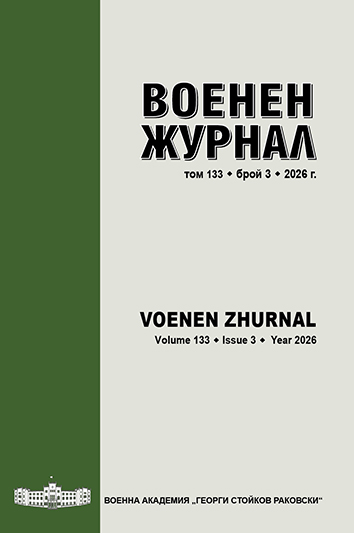
Contents
Policies, Strategies, Leadership
https://doi.org/10.66334/vj-2603-strat
Major General Stayko Prokopiev
Rakovski National Defence College
Abstract. The EU Resilience is defined as “the ability to withstand and cope with risks and challenges, in order to ensure a sustainable, just and democratic transition. The development of the EU resilience is based on a set of resilience strategies, including the “Resilience 2.0” projects, the digital and green transitions, long-term economic stability, etc. The strategic components and instruments of resilience in the EU are defined through the EU Preparedness Strategy, designed to strengthen the EU’s capabilities to predict, prevent and respond to emergencies and crises through increased civil-military cooperation, response coordination and increased resilience. The implementation of the Strategy expands the EU’s global role as a powerful actor in achieving common security by increasing the internal preparedness of individual Member States and the EU as a whole, as well as its cooperation with external partners.
Keywords: sustainability; sustainable development; „Sustainability 2.0“; civil-military cooperation; coordination; EU Preparedness Strategy; EU Preparedness Action Plan; recovery and resilience plans; SAFE financial instrument; Stability and Growth Pact; European Rearmament Plan
https://doi.org/10.66334/vj-2603-bavno
Dr. Nikola Stoyanov, Assoc. Prof.
Rakovski National Defence College
Abstract. The article analyzes the war in Ukraine. The author’s thesis is that we are witnessing a new generation of war, which is the antithesis of the maneuverable war of the Third Generation, called “Blitzkrieg”. The results of the analysis confirm this. The technologies used in the war have led to a remarkable change in some of its characteristics. Thanks to the massive use of unmanned aerial vehicles and satellites, unprecedented situational awareness of commanders has been achieved. This leads to a reduction in ambiguity, a reduction in risk, and a reduction in decision-making time to a few minutes. The strategy and tactics of the war have changed. It has become impossible to create large strike groups to break through the defense of a small area and at great depth. The successful strategy now is not concentration, but dispersion of forces. Armored vehicles have shown their vulnerability to strikes by unmanned aerial systems. The pace of the offensive is very low, with the emphasis not on capturing territory but on destroying the enemy’s resources.
Keywords: war; Ukraine; drones; unmanned aerial systems; strategy; tactics; anti-drone systems; missile defense; electronic warfare
Research, Analysis, Foresees
https://doi.org/10.66334/vj-2603-infra
Dr. Vladimir Babanov, Assist. prof.
South-West University “Neofit Rilski” (Bulgaria)
Abstract. The distinction between a physical and a digital battlefield is becoming less relevant as modern military conflicts are increasing in their complexity as they spill over to multiple domains. Joint All-Domain Operations strategy (JADO), which encompasses all recognized domains, involves an integrated defense of critical civilian systems such as communications, energy, transportation, space, etc. The purpose of this research is to explore how the multi-domain operations could be employed to develop and implement cybersecurity strategies for critical infrastructure protection. This study examines emerging threats to critical infrastructure that are common across multiple security domains, as well as the current joint doctrines of NATO, the United States’ “Joint All-Domain Command-and-Control” (JADC2 Initiative) and the European Union’s “Permanent Structured Cooperation” (PESCO). Using official military documentation and recent cases of conflict, an assessment is conducted on the enabling factors as resilience, interoperability, cyber resilience and others. The obstacles of technical, organizational and legal aspect are also analyzed as detrimental to protecting critical infrastructure against all domain threats. The Discussion section illustrates how integrated operations could support or undermine the security of critical infrastructure. Gaps and limitations of cyber defense methods to protect critical infrastructure in multi-domain attacks are also highlighted. The article extracts recommendations on how to improve the cyber defense of the critical infrastructure in such scenarios.
Keywords: JADO; cyber defense; critical infrastructure; cyberwarfare; hybrid warfare
https://doi.org/10.66334/vj-2603-polzi
Eng. Georgi Enchev
Rakovski National Defence College
Abstract. Contemporary combat conditions position the human factor as a critical element influencing the outcome of military operations, necessitating its consistent analytical consideration within the process of combat effectiveness assessment. In this context, the study examines the discrepancy between the doctrinal recognition of the human factor and the lack of its analytical accounting within national practices for assessing combat potentials. The objective of the research is to substantiate a conceptual framework that enables the systematic examination and methodological positioning of the human factor in this process. As a result of the research, it is proven that the human factor represents a systemic intangible component of combat effectiveness. Its consistent application in national practice requires a clearly structured concept for its methodological positioning. On this basis, conceptual foundations are formulated, creating the conditions for the future development of an applied model for assessing the human factor.
Keywords: potential; combat potentials; human factor; combat effectiveness; combat power; fighting power; doctrinal framework; comparison of combat potentials
https://doi.org/10.66334/vj-2603-siste
Major Ralitsa Borisova, Assist. Prof.
Rakovski National Defence College
Abstract. The article proposes a model for studying and evaluating hybrid operations through the application of system analysis principles. The focus is on considering security as a state of dynamic equilibrium, defined by the ratio between available resources for its maintenance and the generation of uncertainty, amplified by hybrid impacts. The author introduces a holistic interpretation of impacts on security and analyzes the transitions between stable, unstable, and indifferent equilibrium. An analytical framework ”Action – process – result – effect“ is proposed, allowing the identification of critical vulnerabilities through the PMESII model. The complex causal relationship between conducting hybrid operations, their effects on critical state functions, and the subsequent change in the overall security status of the targeted subject is examined.
Keywords: hybrid operations; security; equilibrium; analytical model; effects
https://doi.org/10.66334/vj-2603-ocenka
Colonel Petko Dimov, Assoc. Prof., DSc.
Rakovski National Defence College
Abstract. The integration of generative artificial intelligence in the defense sector represents a critical factor for acquiring strategic and operational superiority in the contemporary hybrid security environment. This article examines the readiness, digital literacy, and risk perceptions among military personnel and civilian defense employees. An empirical study was conducted comparing an experimental group of military personnel and a control group of civilian specialists in early 2026. The statistical analysis reveals a similarly high level of text generator usage (~ 75%), but also significant deficits in technological literacy among military personnel. A critical vulnerability in information security is identified – 35% of military personnel lack a clear understanding of data processing by public commercial models. Autonomous systems and intelligence analysis are identified as areas of highest priority. Practical recommendations for modernizing the curricula in military academies are proposed.
Keywords: artificial intelligence; digital literacy; information security
Theory and practice
https://doi.org/10.66334/vj-2603-artif
Nuran Mahmudov, Mehrac Hüseynov
National Defence University of the Ministry of Defence of the Republic of Azerbaijan
Abstract. This report presents an expanded governance framework for integrating Artificial Intelligence (AI) into national cyber resilience strategies. As modern cyber threats scale algorithmically, traditional static defences and “Human-in-the-Loop” models are failing. The report advocates for a “Human-on-the-Loop” approach, allowing AI systems autonomous response capabilities under strategic human supervision. By synthesizing strategies from Estonia’s cognitive resilience, Israel’s centralized Cyber Dome, and the USA’s secure-by-design approach, a five-pillar governance model is proposed. This model aligns strategic policy, operational coordination, intelligent infrastructure, autonomous response, and explainable AI oversight to ensure national security against advanced threats.
Keywords: Agentic AI; artificial intelligence governance; Cyber Dome; cyber resilience; Human-on-the-Loop; national security; Zero Trust
https://doi.org/10.66334/vj-2603-klima
Mariana Anguelova, PhD Student
Rakovski National Defence College
Abstract. The European Union’s (EU) economic ambitions to achieve climate neutrality are through the European Green Deal to reduce the CO2 emissions for transport with 90% by 2050 (compared to 1990 levels). The requirements for the aviation sector are to contribute significantly to this reduction applying sustainability measures. The EU Strategic Security and Defense Compass calls for full implementation of the Sustainability Roadmap, recognizing that climate change is a multiplier of threats affecting the long-term security of the European Union. It also invites Member States to share national plans on how to contribute to the objectives of the Roadmap. How does military aviation contribute to environmentally sustainable development? What is its role, including as an airspace user, what strategies and initiatives exist in Europe related to sustainability in terms of reducing emissions and the impact of climate change? The article explores how military aviation can proactively adapt to climate challenges by incorporating resilience into operations, infrastructure and technology. A coordinated strategy across military organizations is critical to driving decarbonization while maintaining mission readiness and strategic deterrence. Although reducing greenhouse gas emissions should not compromise defense capabilities, strategic approaches and measures for environmental sustainability could contribute to enhance operational resilience, energy security, and innovation in peacetime. The Republic of Bulgaria is in a position to benefit from the experience of advanced countries and best practices in Europe for sustainable aviation and propose its own strategic approach and national framework for its military aviation.
Keywords: military aviation; climate change; sustainability; Single European Sky; strategic approach; civil-military coordination and cooperation
https://doi.org/10.66334/vj-2603-predi
LTC (OF-4) Dr. Radoslav Chalakov, Assoc. Prof.
Rakovski National Defence College
Abstract. The integration of modern technologies based on artificial intelligence into joint targeting is a key direction in the transformation of modern military capabilities. Artificial intelligence not only accelerates and refines the decision-making process, but also significantly increases the effectiveness of operations through automated information processing, adaptability to changing combat conditions and capabilities for proactive threat prediction.
Keywords: artificial intelligence; joint targeting; decision-making
https://doi.org/10.66334/vj-2603-milit
Dr. Atanaska Popova, Assist. Prof.
Rakovski National Defence College
Abstract. This article examines the impact of militarization on demographic security, focusing on the Russia – Ukraine conflict. Empirical data on birth rates, mortality, migration, and social transformations related to military mobilization and prolonged armed conflict are analyzed. The findings reveal a significant deterioration of demographic indicators in both countries, with military conflicts leading to population decline, increased mortality, and mass internal displacement. The study highlights the necessity for integrated policies combining military strategy with social support and migration management to ensure the resilience of demographic security and social stability in the region.
Keywords: militarization; demographic security; Russia; Ukraine; armed conflict
https://doi.org/10.66334/vj-2603-strikt
Milena Stoyanova
Rakovski National Defence College
Abstract. The popularization of electronic money institutions (EMIs) and the widespread use of virtual international bank account numbers (vIBANs) have significantly transformed the European Union (EU) payment ecosystem. While these innovations increase efficiency, competition and cross-border financial integration, they also introduce vulnerabilities that can be exploited for money laundering purposes and that can threaten the financial security. This article examines the impact of the stringency of national supervisory measures in EU Member States on the risk of money laundering via vIBANs. By analysing publicly available indicators, possible structural patterns of regulatory arbitrage, supervisory stringency and risk are identified and their impact on money laundering via vIBANs is established. This study finds no evidence of a direct relationship between the stringency of supervisory activity and the robustness of the national anti-money laundering system, on the one hand, and the number of licensed EMIs, on the other.
Keywords: vIBAN; money laundering; supervision; e-money institutions; EMIs
The purpose of these Guidelines is to ensure the highest possible visibility of published texts in scientific databases.
The guidelines have been developed in accordance with the current BDS ISO 690:2021 standard – Guidelines for bibliographic references and citations to information resources.
Voenen Zhurnal scientific journal only considers manuscripts that have not been published, or submitted for publication, in another journal. A submitted manuscript that does not fit the journal’s subject matter, or is not formatted according to the Guidelines, will be rejected without going through the anonymous review process.
The manuscript should contain original ideas and scientific results. Detailed presentation of theoretical statements, concepts or definitions freely available from other sources is discouraged. The journal reserves the right not to publish a manuscript found to have high similarity rate.
The manuscript should cite only references used in the text. Self-citations, as well as citation of sources not used in the text, do not contribute to the scientific impact of the manuscript.
A standard word processing program should be used to format the manuscript. Appendices in the form of graphs, tables, or illustrations must be readable and processable with programs commonly used for such purposes.
Preferably, manuscripts should be sent electronically as an attachment to the accompanying e-mail – to the e-mail address: zhurnal@rndc.bg. In the same email, the author should explicitly declare that the manuscript has not already been published or submitted for publication in another journal and that the text does not contain classified information.
Decision on publication will be taken based on the reviewers’ opinion. Editors may edit manuscripts when necessary.
Manuscript should be deemed accepted for publication when the author receives a letter of confirmation. If a confirmation letter is not received within six months within the submission, the author has the right to withdraw the manuscript in written form. The Journal does not make an explicit commitment to inform an author whose manuscript is considered rejected.
Manuscript preparation
General guidelines
- Manuscripts may be submitted in Bulgarian or in English depending on the author’s opinion or on the reviewers recommendation. Manuscripts in other languages could be published at the discretion of the editors.
- It is not recommended to specifically format the text itself with regard to tabs, bullets and other similar symbols. Tabs should be used for table layout only.
- Recommended manuscript length: 40,000 characters (including spaces) – for a research article, and 20,000 characters – for a review. There are no formatting requirements in terms of font type and size.
- Manuscripts should be compiled in the following order:
- title of the paper (without any abbreviations);
- names of the authors with their scientific degree, academic position and institution;
- abstract, that indicates the research goal and methodology, and outlines the research novelty and results. The abstract should correspond to the title, keywords and main text of the study. Recommended abstract volume: 100 – 150 words;
- 3 – 6 keywords, related to the topic, divided by each other with ; ;
- full text;
- acknowledgements (if any) – this is the place to thank other supporters, or to indicate funding for a survey which results lay in the manuscript;
- appendixes (as appropriate);
- notes;
- references;
- full business card of the author(s) – academic position, affiliation, personal ID in scientific databases, name of faculty and/or institution, postal address, e-mail address;
- Figures (illustrations) and their captions, in addition to placing in the main text, should be separately provided in a supplementary file. Where the size of the figures is large and it is not possible to include them in the main text, their place is indicated by remarks (Fig. 1, Fig. 2, etc.).
- Tables should be used for presenting numerical data and dependencies. Plain text tables are not encouraged, as they cause difficulties in reading and understanding the text. Tables and their captions – in addition to placing in the main text – should be separately provided in a supplementary file.
Notes
- Notes are grouped as a separate paragraph after the main text. Their place in the main text is indicated as an upper index as endnotes. The Notes section also consists additional explanations or information, deemed as a burden to the main text.
References
- The References list should contain only sources that are available in long term for checking or referring. All other (marginal) sources, should be listed in the ‘Notes’ section.
- The references list should consist sources in Latin script. If there are sources in Cyrillic script, they should be presented in Latin script – preferably by transliteration, followed by indication for the original language [in square brackets].
- Sources are being arranged in ascending order by last and by first author name, followed by the year of publication. In case of multiple sources with the same author and year, the year is followed by lower case letters (a, b, c…).
- The references are being presented in accordance with the BDS ISO 690: 2021 standard (by name and year – Harvard system). The examples below show how this should be done.
Journal article
Consecutively are being listed author name, year of publication, article title, journal name (in italics), annual volume, issue number, page numbers (separated by a long dash).
REFERENCES
GRIGOROV, M., 2021. Antiteroristichni operatsii – ponyatie i spetsifiki pri provezhdaneto im. Voenen zhurnal, vol. 128, no 1, pp. 77 – 86. ISSN 0861-7392 [in Bulgarian].
Such a source is being indicated in the body text as (Grigorov 2021). If necessary to indicate specific page (e.g. p. 80), the indication is as follows: (Grigorov 2021, p. 80). If an article in an online periodical is cited, after the journal name (in italics), the source of the text (accessible web address or DOI number) should also be placed at the end of the cited source.
LOMAZZI, L.; CADINI, F.; GIGLIO, M. & MANES, A., 2022. Vulnerability
assessment to projectiles: Approach definition and application to helicopter platforms.
Defence Technology, vol. 18, no 9, pp. 1523 – 1537. Available on: https://doi.org/10.1016/j.
dt.2021.09.001. [last viewed: 29 October 2022].
Such a source is indicated in the body text as (Lomazzi, Cadini, Giglio & Manes 2022), or as (Lomazzi et al. 2022).
Books
The book title is given in italics. Mentions also are the city and the publisher of the book.
REFERENCES
NEDYALKOV, D., 2022. 130 godini balgari v nebeto. Kratka istoria na balgarskata voenna aviatsia. Sofia: Prozorets. ISBN 9786192432300. [in Bulgarian].
Such a source is indicated in the body text as (Nedyalkov 2022). If necessary to indicate specific page (e.g. pp. 18 – 19), the indication is as follows: (Nedyalkov 2022, pp. 18 – 19).
Edited books
Only the title of the cited book / collection is given in italics, after the title is indicated the page range of the quoted text.
REFERENCES
YORDANOV, P., 2022. Izsledvane na riskovete za kibersigurnostta vav vaorazhenite sili na Bulgaria. In: Savremenni aspekti na sigurnostta –predizvikatelstva, podhodi, reshenia, pp. 357 – 366. Sofia: Izdatelstvo G.S. Rakovski. [in Bulgarian].
Conclusion
- By submitting a text and/or illustrations for evaluation and possible publication, the author agrees to grant the rights for publication to Voenen Zhurnal for a period, in accordance with the Authorship Rights Bulgarian law. Published text should not be freely distributed, including through academic and social networks for sharing research results (e.g. ResearchGate.net and Academia.edu).
- In academic and social networks for sharing research results, the author only shares the manuscript in the originally submitted for consideration version. If the manuscript is being published, after the publication the author adds to the shared original manuscript the name, volume and issue of the journal in which the text was published.
- Publication of a manuscript does not necessarily imply editorial agreement with the views advocated by the authors.
Бележки
- Архивни източници и бележки се изписват в края на основния текст, на ези-ка на основния текст. Мястото им в текста се отбелязва с горен индекс като endnotes. В „Бележки“, могат да намерят място и допълнителни обяснения или сведения, за които е преценено, че присъствието им в основния текст би го обременило излишно.
Литература
- Списъкът с ползвана литература съдържа само литературни източници, които са достъпни за проверка, или справки. Всички останали източници, вкл. архивни извори, се посочват в раздел „Бележки“.
- Ползваната литература (ако основният текст е на кирилица) се избро-ява в два отделни последователни параграфа. В първия параграф литературата се изброява в оригинал. Във втория – на латиница, се повтаря съдържанието на предишния параграф (чрез транслитерация или в оригинал) (виж https://slovored. com/transliteration/).
- Източниците се подреждат в низходящ ред по фамилия и име на автор, следвана от година на публикуване. При няколко източника с един и същ автор и година, след годината следват малки букви (a, b, c…).
- Представянето на литературните източници в списъка на литературата става в съответствие с БДС ISO 690:2021 (Харвардска система). Примерите по-до-лу показват как трябва да става това.
Статия в списание
Последователно се посочват име на автор, година на издаване, заглавие на статия, име на списание (наклонен шрифт), годишен том, номер на брой, номера на страници (разделени с дълго тире).
ЛИТЕРАТУРА
ГРИГОРОВ, М., 2021. Антитерористични операции – понятие и специфики при провеждането им. Военен журнал, бр. 128, кн. 1, стр. 77 – 86. ISSN 0861-7392.
REFERENCES
GRIGOROV, M., 2021. Antiteroristichni operatsii – ponyatie i spetsifiki pri provezhdaneto im. Voenen zhurnal, vol. 128, no 1, pp. 77 – 86. ISSN 0861-7392 [in Bulgarian].
Такъв източник се цитира в основния текст на латиница като (Grigorov 2021). Ако е нужно да се посочи конкретна страница (напр. стр. 80), се посочва по следния начин: (Grigorov 2021, p. 80).
Ако се посочва статия в онлайн периодично издание, източникът на текста (достъпен уеб адрес или DOI номер) следва да бъде поставен в края на цитирания източник.
LOMAZZI, L.; CADINI, F.; GIGLIO, M. & MANES, A., 2022. Vulnerability
assessment to projectiles: Approach definition and application to helicopter platforms.
Defence Technology, vol. 18, no 9, pp. 1523 – 1537. Available on: https://doi.org/10.1016/j.
dt.2021.09.001. [last viewed: 29 October 2022].
Такъв източник се посочва в основния текст като (Lomazzi, Cadini, Giglio & Manes 2022), или като (Lomazzi et al. 2022).
Книги
С наклонен шрифт се маркира заглавието на книгата. Необходимо е да се посочи също град на издаване и име на издателство. Книгите, публикувани на кирилица, се представят и на латиница в параграфа References.
ЛИТЕРАТУРА
НЕДЯЛКОВ, Д., 2022. 130 години българи в небето. Кратка история на българската военна авиация. София: Прозорец. ISBN 9786192432300.
REFERENCES
NEDYALKOV, D., 2022. 130 godini balgari v nebeto. Kratka istoria na balgarskata voenna aviatsia. Sofia: Prozorets. ISBN 9786192432300.
Такъв източник се цитира в основния текст като (Nedyalkov 2022). Ако е необходимо, се посочва и конкретна страница, напр. (Nedyalkov 2022, pp. 18 – 19).
Книги/сборници с редактор
Само заглавието на цитираната книга/сборник се дава с наклонен шрифт, следват номерата на цитираните страници.
ЛИТЕРАТУРА
ЙОРДАНОВ, П., 2022. Изследване на рисковете за киберсигурността във въоръжените сили на България. В: Съвременни аспекти на сигурността – предизвикателства, подходи, решения, стр. 357 – 366. София: Издателство Г.С. Раковски.
REFERENCES
YORDANOV, P., 2022. Izsledvane na riskovete za kibersigurnostta vav vaorazhenite sili na Bulgaria. In: Savremenni aspekti na sigurnostta – predizvikatelstva, podhodi, reshenia, pp. 357 – 366. Sofia: Izdatelstvo G.S. Rakovski.
- С изпращането на текст и/или илюстрации за оценяване и евентуално последващо публикуване, авторът се съгласява да предостъпи на сп. Военен журнал правата върху публикувания текст за определен период, съгласно ЗАПСП. Публи-куван текст не следва да се разпространява свободно, включително и чрез акаде-мични и социални мрежи за споделяне на резултати от научни изследвания (напр. ResearchGate.net и Academia.edu).
The purpose of these Guidelines is to ensure the highest possible visibility of published texts in scientific databases.
The guidelines have been developed in accordance with the current BDS ISO 690:2021 standard – Guidelines for bibliographic references and citations to information resources.
Voenen Zhurnal scientific journal only considers manuscripts that have not been published, or submitted for publication, in another journal. A submitted manuscript that does not fit the journal’s subject matter, or is not formatted according to the Guidelines, will be rejected without going through the anonymous review process.
The manuscript should contain original ideas and scientific results. Detailed presentation of theoretical statements, concepts or definitions freely available from other sources is discouraged. The journal reserves the right not to publish a manuscript found to have high similarity rate.
The manuscript should cite only references used in the text. Self-citations, as well as citation of sources not used in the text, do not contribute to the scientific impact of the manuscript.
A standard word processing program should be used to format the manuscript. Appendices in the form of graphs, tables, or illustrations must be readable and processable with programs commonly used for such purposes.
Preferably, manuscripts should be sent electronically as an attachment to the accompanying e-mail – to the e-mail address: zhurnal@rndc.bg. In the same email, the author should explicitly declare that the manuscript has not already been published or submitted for publication in another journal and that the text does not contain classified information.
Decision on publication will be taken based on the reviewers’ opinion. Editors may edit manuscripts when necessary.
Manuscript should be deemed accepted for publication when the author receives a letter of confirmation. If a confirmation letter is not received within six months within the submission, the author has the right to withdraw the manuscript in written form. The Journal does not make an explicit commitment to inform an author whose manuscript is considered rejected.
Manuscript preparation
General guidelines
- Manuscripts may be submitted in Bulgarian or in English depending on the author’s opinion or on the reviewers recommendation. Manuscripts in other languages could be published at the discretion of the editors.
- It is not recommended to specifically format the text itself with regard to tabs, bullets and other similar symbols. Tabs should be used for table layout only.
- Recommended manuscript length: 40,000 characters (including spaces) – for a research article, and 20,000 characters – for a review. There are no formatting requirements in terms of font type and size.
- Manuscripts should be compiled in the following order:
- title of the paper (without any abbreviations);
- names of the authors with their scientific degree, academic position and institution;
- abstract, that indicates the research goal and methodology, and outlines the research novelty and results. The abstract should correspond to the title, keywords and main text of the study. Recommended abstract volume: 100 – 150 words;
- 3 – 6 keywords, related to the topic, divided by each other with ; ;
- full text;
- acknowledgements (if any) – this is the place to thank other supporters, or to indicate funding for a survey which results lay in the manuscript;
- appendixes (as appropriate);
- notes;
- references;
- full business card of the author(s) – academic position, affiliation, personal ID in scientific databases, name of faculty and/or institution, postal address, e-mail address;
- Figures (illustrations) and their captions, in addition to placing in the main text, should be separately provided in a supplementary file. Where the size of the figures is large and it is not possible to include them in the main text, their place is indicated by remarks (Fig. 1, Fig. 2, etc.).
- Tables should be used for presenting numerical data and dependencies. Plain text tables are not encouraged, as they cause difficulties in reading and understanding the text. Tables and their captions – in addition to placing in the main text – should be separately provided in a supplementary file.
Notes
- Notes are grouped as a separate paragraph after the main text. Their place in the main text is indicated as an upper index as endnotes. The Notes section also consists additional explanations or information, deemed as a burden to the main text.
References
- The References list should contain only sources that are available in long term for checking or referring. All other (marginal) sources, should be listed in the ‘Notes’ section.
- The references list should consist sources in Latin script. If there are sources in Cyrillic script, they should be presented in Latin script – preferably by transliteration, followed by indication for the original language [in square brackets].
- Sources are being arranged in ascending order by last and by first author name, followed by the year of publication. In case of multiple sources with the same author and year, the year is followed by lower case letters (a, b, c…).
- The references are being presented in accordance with the BDS ISO 690: 2021 standard (by name and year – Harvard system). The examples below show how this should be done.
Journal article
Consecutively are being listed author name, year of publication, article title, journal name (in italics), annual volume, issue number, page numbers (separated by a long dash).
REFERENCES
GRIGOROV, M., 2021. Antiteroristichni operatsii – ponyatie i spetsifiki pri provezhdaneto im. Voenen zhurnal, vol. 128, no 1, pp. 77 – 86. ISSN 0861-7392 [in Bulgarian].
Such a source is being indicated in the body text as (Grigorov 2021). If necessary to indicate specific page (e.g. p. 80), the indication is as follows: (Grigorov 2021, p. 80). If an article in an online periodical is cited, after the journal name (in italics), the source of the text (accessible web address or DOI number) should also be placed at the end of the cited source.
LOMAZZI, L.; CADINI, F.; GIGLIO, M. & MANES, A., 2022. Vulnerability
assessment to projectiles: Approach definition and application to helicopter platforms.
Defence Technology, vol. 18, no 9, pp. 1523 – 1537. Available on: https://doi.org/10.1016/j.
dt.2021.09.001. [last viewed: 29 October 2022].
Such a source is indicated in the body text as (Lomazzi, Cadini, Giglio & Manes 2022), or as (Lomazzi et al. 2022).
Books
The book title is given in italics. Mentions also are the city and the publisher of the book.
REFERENCES
NEDYALKOV, D., 2022. 130 godini balgari v nebeto. Kratka istoria na balgarskata voenna aviatsia. Sofia: Prozorets. ISBN 9786192432300. [in Bulgarian].
Such a source is indicated in the body text as (Nedyalkov 2022). If necessary to indicate specific page (e.g. pp. 18 – 19), the indication is as follows: (Nedyalkov 2022, pp. 18 – 19).
Edited books
Only the title of the cited book / collection is given in italics, after the title is indicated the page range of the quoted text.
REFERENCES
YORDANOV, P., 2022. Izsledvane na riskovete za kibersigurnostta vav vaorazhenite sili na Bulgaria. In: Savremenni aspekti na sigurnostta –predizvikatelstva, podhodi, reshenia, pp. 357 – 366. Sofia: Izdatelstvo G.S. Rakovski. [in Bulgarian].
Conclusion
- By submitting a text and/or illustrations for evaluation and possible publication, the author agrees to grant the rights for publication to Voenen Zhurnal for a period, in accordance with the Authorship Rights Bulgarian law. Published text should not be freely distributed, including through academic and social networks for sharing research results (e.g. ResearchGate.net and Academia.edu).
- In academic and social networks for sharing research results, the author only shares the manuscript in the originally submitted for consideration version. If the manuscript is being published, after the publication the author adds to the shared original manuscript the name, volume and issue of the journal in which the text was published.
- Publication of a manuscript does not necessarily imply editorial agreement with the views advocated by the authors.